
Understanding High School Profiles: What Every College Applicant Should Know
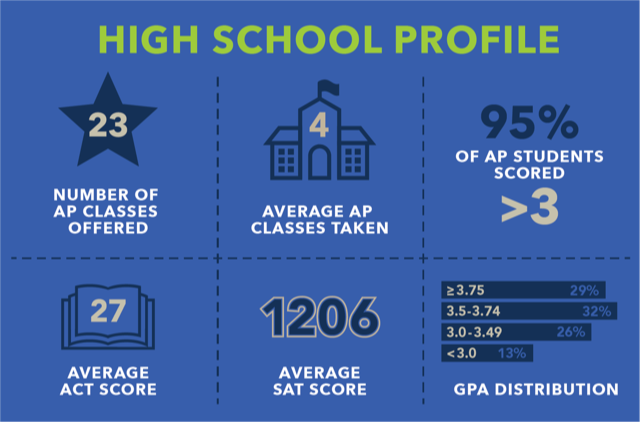
High schools have a variety of grading scales, grade distributions, average ACT/SAT scores, and availability of Advanced Placement (AP) or International Baccalaureate (IB) courses. To provide admissions officers with context for understanding a student’s academic experience, high schools send colleges a high school profile. In this blog post, we’ll explore the key differences in high schools that influence how colleges evaluate students.
Grading Scales
One significant variation between high schools is their grading scale. Many use a traditional 4.0 scale, where an A is a 4.0, a B is a 3.0, and so on. However, other schools have more nuanced systems:
Some use a 100-point grading system. Most consider anything 90 and above an A (or an A- for a 90–92 if they use plusses and minuses), while others set a more stringent standard, requiring a 93 or higher to earn an A, so a 91 or 92 would be a B.
The majority of high schools, such as Maple Grove (MN) Senior High, provide a weighted GPA by adding points to AP or IB classes. Some also add points for dual enrollment and/or honors classes.
Occasionally, schools like those in the Atlanta Public Schools, such as North Atlanta High School, only list weighted grades on the transcript and add 10 points (on a 100-point scale) for AP, IB, or core dual enrollment courses. Seeing only weighted grades on the transcript might give students a false sense of how strong their grades are. Colleges that recalculate GPA will remove the weighting these high schools add. Thus, what initially may appear to be a B in an AP or IB class is actually a C as awarded by the teacher.
Grade Distribution: Is There Inflation or Deflation?
An increasing number of high schools have grade inflation, making it difficult for colleges to distinguish between students at the top of the class—especially since most schools no longer rank students. A small percentage of schools, like Atlanta Classical Academy (ACA), are transparent and show the quartile ranges for students’ unweighted GPAs. With only one-quarter of the class earning GPAs of 3.90 or above—and another quarter at 3.24 or below—ACA’s GPA distribution suggests a wide spread of grades, indicating that earning As consistently is more challenging than at many high schools.
AP and IB Offerings—and Schools That Have Neither
When reviewing a transcript, colleges will look at which AP courses a student took compared to what was available. Glenbrook North High School in suburban Chicago offers 28 AP classes. Other schools may only have a few APs. If many APs are available, which ones you take matters, as AP classes vary in rigor; for example, AP Environmental Science is not viewed as rigorous as AP Biology or AP Chemistry. A growing number of schools participate in the IB Diploma Programme (IBDP), where students take a mixture of Higher Level (HL) and Standard Level (SL) classes; which HL classes a student takes can matter. Some high schools, such as Phillips Exeter Academy, don’t offer AP or IB classes and use their own system of categorizing the rigor of their classes.
SAT and ACT Score Averages
SAT and ACT scores can vary significantly among high schools. Getting a 28 on the ACT might be one of the top scores at an under-resourced school, yet below average at others, like the Harvard-Westlake School in Los Angeles, which has an average ACT of 32. Colleges may view test scores in the context of the high school, so simply looking at a college’s middle 50% test score range for admitted students may not tell the whole story. Some test-optional colleges, though, are clear in their guidance that students should not submit an ACT or SAT score below the institution’s middle 50% range, regardless of school context.
Conclusion
When evaluating your high school transcript and application as a whole, colleges consider much more than just your GPA. They look closely at the high school profile—which will show the school’s grading scale, availability of advanced coursework, ACT/SAT averages, and overall resources—and how your curriculum rigor, grades, and test scores fit within your school’s broader context.
An earlier version of this blog was published as a guest blog for Edison Prep and can be found here. This blog has been revised slightly, and the school profiles have been updated.